Monday, October 31, 2022

Pump Up the (NBA) Jam

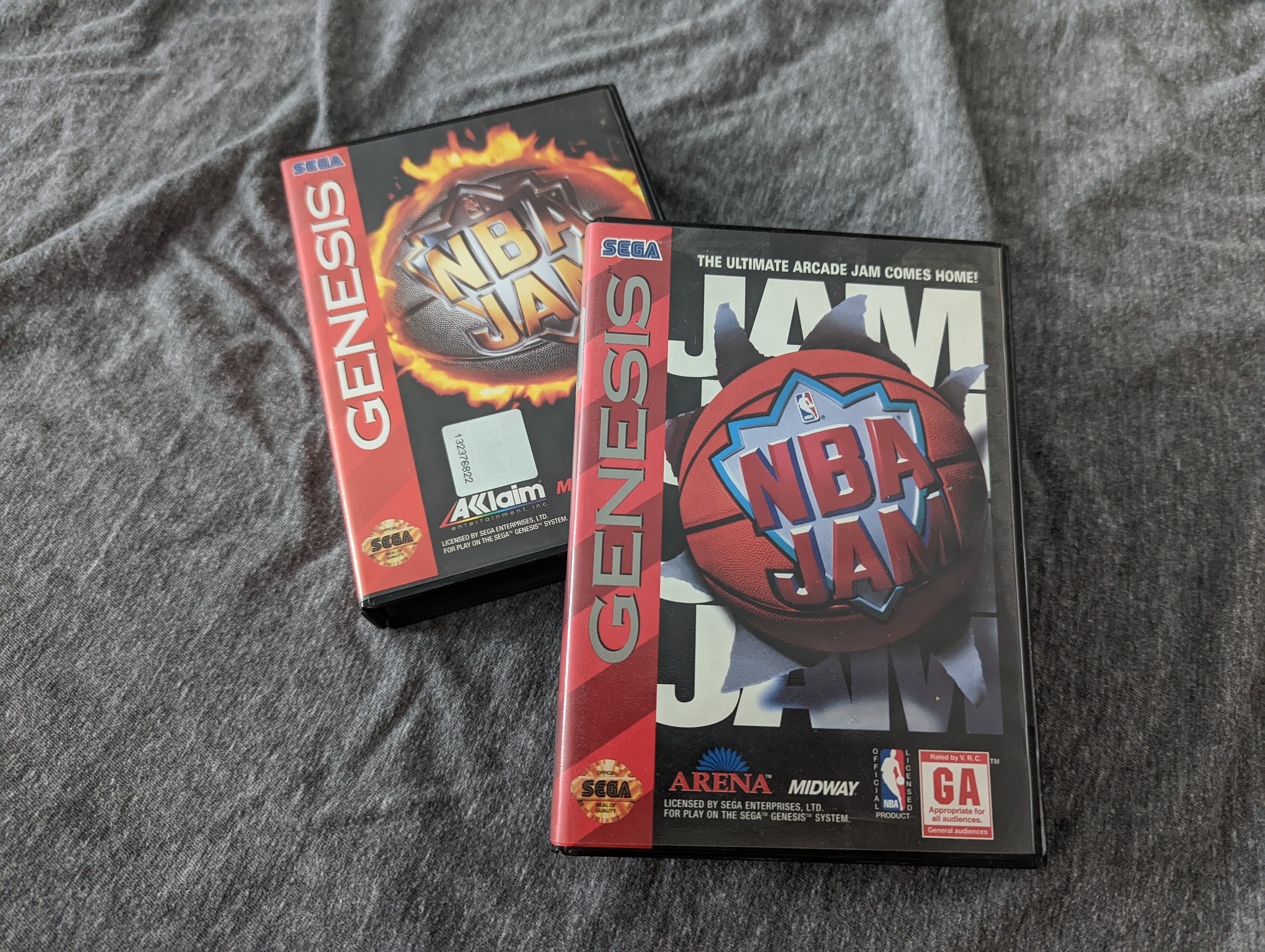
NBA Jam and NBA Jam: Tournament Edition for the Sega Genesis
Sega CD Summer has launched! This is the eleventh entry in the Sega Tote Series

Video games and sports are just one of those perfect combinations, like peanut butter and jelly or chocolate and peanut butter. They just go together.

Video games let us do things we're incapable of, like flying spaceships, blasting aliens, and dunking all the way from half court. NBA Jam excelled at the latter, of course.

The arcade hit came to the Sega Genesis in March 1994. It plays a minor role in Sega CD Summer, mentioned as one of the few sports games Tommy's friends would enthusiastically play with him. Tommy also comments on his love for the Indiana Pacers, a team featuring NBA all-timer Reggie Miller and the solid-in-real-life-but-kind-of-useless-in-the-game Derrick McKey. 

From the book:
As much as my friends and I liked giving each other crap, we were always supportive. Andy and Kyle didn’t have much interest in sports, but they didn’t mind it when I talked about the baseball team or wanted to play NHL ’94 or Madden. They drew the line at most baseball video games, and the only basketball game they could stand was NBA Jam.

Heck, Kyle even owned a copy of NBA Jam. The two-on-two, officially licensed basketball game was pure arcade craziness, with over-the-top dunks and players. I always played as the Indiana Pacers so I could rain three-pointers with the legendary Reggie Miller, while Derrick McKey brought surprisingly little to the table. While he could dunk okay, he was slow and couldn’t shoot. Also, his defensive rating was poor. The Tournament Edition added Rik Smits, who was also slow and couldn’t shoot. His Dunkin’ Dutchman power was completely misrepresented in the rankings, but he could block shots. I always stuck with Reggie Miller and Rik Smits—at least TE gave me the option of benching McKey.
NBA Jam was a certifiable phenomenon in the mid-90s, right up there with Street Fighter II and Mortal Kombat in terms of gaming hype and hours logged. Because of the over-the-top gameplay and presentation ("BOOMSHAKALAKA!"; "He's on fire!"; "Rejected!"; "Is it the shoes?"), the game got that all-important crossover appeal that expanded the gaming audience beyond sports fans.

The game is simple, really, just two-on-two basketball featuring officially licensed NBA teams and players. Most basketball rules get tossed out the window, and the team with the most points at the end wins, obviously. An exuberant announcer and crowd reactions give each game great atmosphere. It's probably best known for jaw-dropping, turbo-enhanced dunks that have players going high into the air, windmilling or sometimes spinning as they throw one down.

The game had some wicked rubber-banding AI that always kept things close in CPU games, dropping your field goal percentage and upping the computer's success rate to keep things "interesting."

I almost always played as the Pacers, but there were some other fun duos, including Sean Elliott and David Robinson on the Spurs; Larry Johnson and Alonzo Mourning on the Hornets; Karl Malone and John Stockton on the Jazz; and Vernon Maxwell and Hakeem Olajuwon on the Rockets. I'll even begrudgingly throw in John Starks and Patrick Ewing on the Knicks, just because it gave me much satisfaction to beat them with Reggie Miller.


It's worth mentioning that, thanks to the complexities of licensing, the home ports lacked Shaquille O'Neal and Michael Jordan. While some early Genesis/SNES versions had Charles Barkley, he was later replaced with Dan Majerle thanks to a deal with Accolade for Barkley: Shut Up and Jam, a venture I'm sure was worthwhile for everyone (eyeroll). 

NBA Jam also had several cheat codes and secret characters. You could play in Big Head Mode, for example, or throw one down as Al Gore or Bill Clinton, respectively the vice president and president at the time.

A year after the original Jam hit home consoles, NBA Jam: Tournament Edition arrived. It featured the same fast gameplay, secrets, and atmosphere. The game had expanded rosters and you could do substitutions between quarters. I liked the optional addition of "hotspots," different areas of the court that would light up and reward you with higher point values if you hit a shot.

The Sega CD and Game Gear also received ports of NBA Jam. The Sega CD version, as you'd expect, featured CD-quality music, a few roster updates, and FMV sequences at halftime. Players had to contend with long load times, however, and the graphics weren't much of an upgrade from the Genesis version. 


The Game Gear port tried hard, as Game Gear ports often did, and although it's graphically and aurally inferior, it's possible to have some fun with it.

Friday, October 28, 2022

Mall Madness Memories

Sega CD Summer is out now!

Malls still exist today, but they just aren't what they used to be.

I live on the south side of Indianapolis, and the closest one to us is the Greenwood Park Mall. Over the years, it's undergone renovations and additions in an effort to attract more customers. It seems like stores open and close all the time.

It's just not the same mall experience I had as a kid.

Richmond, Indiana, never had the greatest mall in the world. My mother always laughed at the "mall directory" because you could see all the stores from one end to the other from the entrance. Still, I liked going there. 

You had Waldenbooks, which was the bookstore where I bought the bulk of my books and video game magazines. There was just something great about asking the bookstore to hold a novel for you and then picking it up after it was released. I loved browsing through the big wall of magazines there and finding some issue of GamePro or Electronic Gaming Monthly with a cool cover. I also got the occasional sports magazine there.

My favorite section, of course, featured science fiction and fantasy books. To be honest, my "science fiction and fantasy" reading was pretty much limited to Star Wars and Star Trek books. I rarely left Waldenbooks without a paperback of some sort. Most of my Star Trek books were paperbacks while I had several hardcovers in the Star Wars series. Favorites included the Timothy Zahn Heir to the Empire trilogy and Steve Perry's Shadows of the Empire. None of those books "count" in the current Star Wars canon, of course.

Chapter 9 of Sega CD Summer dramatizes a trip to the mall, with Tommy visiting Electronics Boutique with his mother. I thought the store was incredible, packed with almost every game and system I could imagine. Electronics Boutique also featured PC games and components; it's the first place I can ever recall seeing a CD-ROM drive.

Games were arranged on wire shelves with the price marked on a placard below. If you wanted one, you took the case up to the register and paid for your game; the employee then retrieved a copy from a locked drawer. It was similar to the Target/Kmart/Sears purchasing process in which games were kept in locked cabinets. KB Toys, on the other hand, used a "ticket" system in which you pulled the ticket for the game you wanted and took it up to the counter.

Ah, yes. KB Games. Like most everything else in the mall, the products were overpriced and the store was kind of cramped. However, you could find things at KB that were hard to come by at Target or Kmart--you'd just pay a little more for them. For the most part, I was content with the selection of G.I. Joes at Target, but every once in a while, KB Toys would have that special figure I was looking for.

Five of the games pictured above came from the Sears bargain bin
KB also had a decent bargain bin for video games when it was clearing stock. A couple of games I remember buying from there include Zero Tolerance, a first-person shooter that was actually decent for a console shooter of the era, and Cosmic Spacehead, a game that wasn't worth the $15 I paid for it.

The champion of discount games, however, was Sears. The electronics section there was small, but Sears usually had discounted Sega CD games. I bought FIFA and NHL '94 there for cheap, along with Links: The Challenge of Golf. I believe AH-3 Thunderstrike and The Software Toolworks Star Wars Chess also came from Sears!

For the most part, Sears, JCPenney, and their ilk are irrelevant these days. But for those of us who grew up in the '80s and '90s, the mall was a magical place to hang out with friends, spend some time at the arcade, and do some clothes shopping. That's because the mall had everything all in one place. 

Thursday, October 27, 2022

The Major League Breaking Ball

The Major League Breaking Balls (both of them) modeled by the "real" Terry Guggenbiller
The Major League Breaking Ball makes a couple appearances in Sega CD Summer

It's a training tool my father, the "real" Terry Guggenbiller, believes he bought from Baseball Digest when my brother was 12 and I was 8. That would make these Major League Breaking Balls about 34 years old!

During a recent trip back home, I asked my dad if he still had the balls. They were sitting in a bucket inside the back of his RAV4 with some baseball gloves and a bucket full of actual baseballs. I decided it would be fun to get a few pictures of the balls, which we used from about 1988 through the end of my high school baseball career in 1999.

We were struck by the visual similarity in the big chips between both balls! I think they're made of hard plastic, although they have a kind of ceramic feel to them. He definitely got his money's worth out of these bizarre training tools.

This gives you a look at the MLBB, which is about three-quarters of a real baseball with a flat side
What's the purpose of the Major League Breaking Ball? It allows pitchers to simulate a pro-level breaking pitch in batting practice, giving the batter a look at a sweeping curveball you'd see in higher levels of baseball.

Dad, an excellent BP arm who could throw with some zip, never thought he had a very good curveball. The absurd-looking training tool allowed him to throw an incredible one. He conceded he would aim for my head and hope the pitch did what it was supposed to do. I can tell you without a shadow of a doubt that the thing was amazing, resulting in a sweeping pitch that looked like it would maybe go behind you before ending up in the middle of the plate. 

He mixed the breaking balls in with regular baseballs during batting practice and didn't tip his hand so my brother and I would learn to adjust to breaking pitches.

Another look at the breaking balls
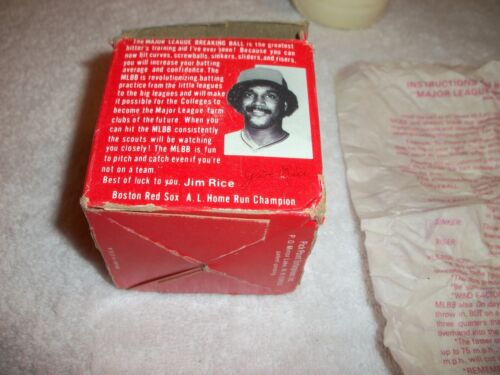
The Major League Breaking Ball isn't essential to the book or its plot; it's simply something Terry Guggenbiller uses during batting practice, much as my father did when I was a young baseball player. I thought it would be fun to show people the strange baseballs, which came in a red box and featured the endorsements of Boston Red Sox slugger Jim Rice and Baltimore Orioles pitcher Mike Flanagan.

Because the internet is forever and remembers everything, you can still find the odd Major League Breaking Ball for sale on eBay. One listing has it for $39.95 with the original box and instruction sheet.

This is the side of the original box featuring Jim Rice. The photo comes from the eBay listing referenced above.
A different eBay listing has the Major League Breaking Ball for $8.99 sans the box and instructions. While that listing said the ball has some minor scuffs, it's in much better condition than the two currently residing in Williamsburg, Indiana, which have been chipped as a result of mighty swings from Tommy Guggenbiller and Craig the Baseball Prodigy.

While I'm on the subject of curveballs, I may as well vouch for the authenticity of a scene from Sega CD Summer in which Tommy gets plunked not once but twice by a "curveball" thrown by his beloved baseball coach, Swearin' Sammy Reed.

Though the names in that story have been changed, it is 100% true. In this case, I was Tommy Guggenbiller and Swearin' Sammy was the late, great Mike Ryan, my youth baseball coach for many seasons in Williamsburg. Too bad the coaches didn't have the Major League Breaking Ball to save their players from bruised hips--and themselves from bruised egos.