The blockbuster sequel to the blockbuster sequel to the original blockbuster hit I, Crimsonstreak is Crimsonstreaking onward!
I've hit the 40,000 word mark in III Crimsonstreak: Subtitle Undetermined. It follows II Crimsonstreak: Subtitle Undetermined and the first book, I, Crimsonstreak, which had no subtitle.
Currently, our hero is trapped in the 1970s, an era that confounds and frustrates him because no one gets his pop culture references. To reveal more--such as the reason he's there or who he's with--would spoil both the book and its predecessor.
I should probably add that its predecessor has neither been released or its existence confirmed in the form of a binding contract.

Showing posts with label writing. Show all posts
Showing posts with label writing. Show all posts
Wednesday, December 5, 2012
Monday, June 25, 2012
Analyze Your Writing Style
I was having fun with the I Write Like tool. I took random passages from several of my novels and plugged them into the analyzer to see what would happen.
Here's what the tool found.
The Franchise:
Seven:
I, Crimsonstreak:
Sheridan's Hammer:
17th Parallel:
Mortimer P. Willoughby's Guide to Superhero Etiquette (12th Edition):
I don't know the metrics involved here and obviously the analysis can't include things like tone and symbolism, but it's an interesting exercise. It's not exact, of course. Different sections of The Franchise returned different results (Arthur C. Clarke, Stephen King, and Charles Dickens--although the Clarke analysis was remarkably consistent). The program isn't suggesting my writing is up to the level of those great authors--it's simply saying there's an echo of their style and word choice reflected in my prose.
A fun exercise nonetheless.
I took a few sections of text from some of the authors I've recently read...here's what the program came up with:
Adam Christopher (Empire State, Angry Robot)
Susan Jane Bigelow (Broken, Candlemark & Gleam)
Ray Bradbury (The Martian Chronicles)
George R.R. Martin (A Clash of Kings, Bantam)
Robert Louis Stevenson (Treasure Island)

Timothy Zahn (Star Wars: Allegiance, LucasBooks)
Jane Austen (Pride & Prejudice)
Chuck Wendig (Blackbirds, Angry Robot)
Stephen Zimmer (Crown of Vengeance - Fires of Eden Series), Seventh Star Press)
Random Amazon Review for a Computer:
So...um...not an exact science, right?
Which author do you write like?
Click here to find out (it's a simple copy & paste of your text) & drop your answer in the comments.
Here's what the tool found.
The Franchise:
Seven:
I, Crimsonstreak:
Sheridan's Hammer:
17th Parallel:
Mortimer P. Willoughby's Guide to Superhero Etiquette (12th Edition):
I don't know the metrics involved here and obviously the analysis can't include things like tone and symbolism, but it's an interesting exercise. It's not exact, of course. Different sections of The Franchise returned different results (Arthur C. Clarke, Stephen King, and Charles Dickens--although the Clarke analysis was remarkably consistent). The program isn't suggesting my writing is up to the level of those great authors--it's simply saying there's an echo of their style and word choice reflected in my prose.
A fun exercise nonetheless.
I took a few sections of text from some of the authors I've recently read...here's what the program came up with:
Adam Christopher (Empire State, Angry Robot)
Susan Jane Bigelow (Broken, Candlemark & Gleam)
Ray Bradbury (The Martian Chronicles)
George R.R. Martin (A Clash of Kings, Bantam)
Robert Louis Stevenson (Treasure Island)
I write like
Robert Louis Stevenson
Robert Louis Stevenson
I Write Like by Mémoires, journal software. Analyze your writing!
Timothy Zahn (Star Wars: Allegiance, LucasBooks)
Jane Austen (Pride & Prejudice)
Chuck Wendig (Blackbirds, Angry Robot)
Stephen Zimmer (Crown of Vengeance - Fires of Eden Series), Seventh Star Press)
Random Amazon Review for a Computer:
So...um...not an exact science, right?
Which author do you write like?
Click here to find out (it's a simple copy & paste of your text) & drop your answer in the comments.

Friday, December 30, 2011
Writing Resolutions for 2012
I drafted this blog post on New Year's Eve, but I didn' really flesh it out until today.
So, belated and on a Friday, here's a look at my Writing Resolutions for 2012.
Write more...and more often. I have the capability to write prolifically. I know this. Last year, I probably wrote between 250,000 and 350,000 words (that includes short stories, novels, and blog posts...and that estimate may be underselling it). I'm capable of writing more. Revisions on I, Crimsonstreak cut into "new" writing content. While working on a sequel, I averaged about 2,000 words a day for three months. In 2012, I resolve to bring that kind of consistency to the table.
Blog more. I run hot and cold in terms of blog content. It's tough. I, like many writers, have a full-time job. And, like many writers, I also try to tweet, Facebook, and blog on top of the actual writing. Hours in a day are numbered, and that means finding time can be a challenge. In 2012, I resolve to blog more often. I want to do more reviews (books, movies, etc.). I want to do more video blogs (I did ONE last month as an experiment). I want to do a "How to" series (I did a soft launch of this last year). I have a major opportunity this year. My very first book will be released. It's not going to make me a multi-millionaire. It may not even make me a multi-hundred-aire. However, people who read it may be interested in learning more about my writing. I want to make sure I have plenty of solid blog content for them.
Read more. I've been better about this. I've read three books in the George R.R. Martin "A Song of Ice and Fire" series. That's the same as reading, like, 20 books. I've also read The Accidental Billionaires, Empire State, Raise the Titanic, Ready Player One, and a few others. Ever since I bought a Kindle over the summer, I've found myself reading more often. Part of it's the gadget "cool" factor; part of it's the convenience factor. What's really helped, however, is the Kindle library lending feature. I can check out books from the Indianapolis Marion County Public Library without leaving home. It fits my schedule and it fits my budget. In 2012, I want to continue that momentum.
Publish a short story in a major market. I'd like to join the Science Fiction and Fantasy Writers of America. In order to do that, you have to publish a book in certain markets or sell three stories to certain markets. I've had modest (and I do mean modest in its purest sense) success with some short stories. Now, I want to sell a few to some of the bigger markets. This will get exposure and help me become eligible for the SFWA. In order to do that, of course, I have to actually submit some stories. I've been so focused on I, Crimsonstreak in the last few months that I haven't concentrated as much on my short fiction. In 2012, I resolve to balance novels and short stories.
Get a few bites on my next project. I've written a sequel to I, Crimsonstreak and it needs a lot of work. I know this. However, that's not the "next" project I'm referring to. I have another manuscript that also needs some more polish. I believe it's a more marketable/mainstream work than Crimsonstreak. In 2012, I resolve to give this to my beta readers and send it along the query route to see if I can get someone to bite.
So, belated and on a Friday, here's a look at my Writing Resolutions for 2012.
Write more...and more often. I have the capability to write prolifically. I know this. Last year, I probably wrote between 250,000 and 350,000 words (that includes short stories, novels, and blog posts...and that estimate may be underselling it). I'm capable of writing more. Revisions on I, Crimsonstreak cut into "new" writing content. While working on a sequel, I averaged about 2,000 words a day for three months. In 2012, I resolve to bring that kind of consistency to the table.
Blog more. I run hot and cold in terms of blog content. It's tough. I, like many writers, have a full-time job. And, like many writers, I also try to tweet, Facebook, and blog on top of the actual writing. Hours in a day are numbered, and that means finding time can be a challenge. In 2012, I resolve to blog more often. I want to do more reviews (books, movies, etc.). I want to do more video blogs (I did ONE last month as an experiment). I want to do a "How to" series (I did a soft launch of this last year). I have a major opportunity this year. My very first book will be released. It's not going to make me a multi-millionaire. It may not even make me a multi-hundred-aire. However, people who read it may be interested in learning more about my writing. I want to make sure I have plenty of solid blog content for them.
Read more. I've been better about this. I've read three books in the George R.R. Martin "A Song of Ice and Fire" series. That's the same as reading, like, 20 books. I've also read The Accidental Billionaires, Empire State, Raise the Titanic, Ready Player One, and a few others. Ever since I bought a Kindle over the summer, I've found myself reading more often. Part of it's the gadget "cool" factor; part of it's the convenience factor. What's really helped, however, is the Kindle library lending feature. I can check out books from the Indianapolis Marion County Public Library without leaving home. It fits my schedule and it fits my budget. In 2012, I want to continue that momentum.
Publish a short story in a major market. I'd like to join the Science Fiction and Fantasy Writers of America. In order to do that, you have to publish a book in certain markets or sell three stories to certain markets. I've had modest (and I do mean modest in its purest sense) success with some short stories. Now, I want to sell a few to some of the bigger markets. This will get exposure and help me become eligible for the SFWA. In order to do that, of course, I have to actually submit some stories. I've been so focused on I, Crimsonstreak in the last few months that I haven't concentrated as much on my short fiction. In 2012, I resolve to balance novels and short stories.
Get a few bites on my next project. I've written a sequel to I, Crimsonstreak and it needs a lot of work. I know this. However, that's not the "next" project I'm referring to. I have another manuscript that also needs some more polish. I believe it's a more marketable/mainstream work than Crimsonstreak. In 2012, I resolve to give this to my beta readers and send it along the query route to see if I can get someone to bite.
Saturday, October 22, 2011
The Writer Fantasy Camp Experience
Writing, like professional sports, is full of big-time money, glamor, and adventure.
And the staff at the Matt Adams Writing Experience wants you to live the dream!

The Matt Adams Writing Experience is like baseball fantasy camp...for writers!
During this intensive, two-week experience, you will endure the ups and downs of the life of a writer, from juggling a day job and writing to fulfilling your daily word count, submitting your work, handling rejection, and much more!
Eat Like a Pro Writer!
As a Fantasy Writer, you will be required to cover the costs of your own meals at our Virtual Writers Store unless...
Write to Eat!
Fantasy writers who manage to publish a story will be awarded a meal voucher for the Virtual Writers Store!

Selection may vary by region. Prices non-negotiable.
Live the Life!
Fantasy Writers will work a full eight-hour day at a vocation of the staff's choosing. They will then have the option of waking up before this day job to write or waiting until after work to meet their required daily word count.
Work like the Pros!
Fantasy Writers will settle for the mediocre tools used by real writers! PC's! Notebooks! The possibilities are endless!

Standard work station pictured. Zebra statue and Colts desk calendar not included.
Write in Pure Comfort!
Fantasy Writers will enjoy the full benefits of an average writing chair! It tilts, it spins, it leans back...it even has armrests!
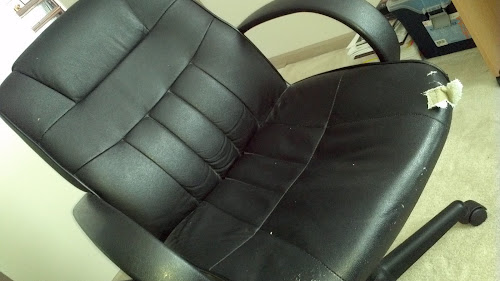
Standard writing chair pictured with standard two weeks of wear and tear.
Go Inside the Submission Process!
In addition to meeting daily word counts, guests will scour the internet for markets for their short story and divide their writing time between writing and composing cover letters!
Sell Your Work...to an Agent!
Fantasy Writers with completed manuscripts will release their work out into "the wild" to find that perfect agent, but...
Walk Down Rejection Avenue!

Fantasy Writers with perfectly-polished prose will receive authentic form rejection letters for their efforts!

Standard rejection letter. Results typical.
Keep Trying!
As the short stories and rejection letters pile up, Fantasy Writers will be asked to keep submitting!

Standard "Bang Head Here" sign. Multiple stations available for multiple visits.
Prepare to Give Up!
As the visits to Rejection Avenue continue to pile up, Fantasy Writers will have the option of torching their manuscripts.

Standard manuscript bonfire. Results typical, but not recommended.
Choose Your Path!
Explore self-publishing, small press, and traditional Big Six publishing...all while our staff advises you on why none of those options will work for you!
Hang in There!
Fantasy Writers who keep writing, revising, submitting, revising, writing, revising, submitting, writing, revising, and submitting may just make it big!

Standard book contract. Results not guaranteed, though achievable through persistence.
The Matt Adams Writing Experience is now taking applications for Fantasy Writers!
The magical, transformative two-week course costs only $4,900!*
*Includes $500 deposit. Deposit is nonrefundable, even in the case of death.
And the staff at the Matt Adams Writing Experience wants you to live the dream!

The Matt Adams Writing Experience is like baseball fantasy camp...for writers!
During this intensive, two-week experience, you will endure the ups and downs of the life of a writer, from juggling a day job and writing to fulfilling your daily word count, submitting your work, handling rejection, and much more!
Eat Like a Pro Writer!
As a Fantasy Writer, you will be required to cover the costs of your own meals at our Virtual Writers Store unless...
Write to Eat!
Fantasy writers who manage to publish a story will be awarded a meal voucher for the Virtual Writers Store!

Live the Life!
Fantasy Writers will work a full eight-hour day at a vocation of the staff's choosing. They will then have the option of waking up before this day job to write or waiting until after work to meet their required daily word count.
Work like the Pros!
Fantasy Writers will settle for the mediocre tools used by real writers! PC's! Notebooks! The possibilities are endless!

Write in Pure Comfort!
Fantasy Writers will enjoy the full benefits of an average writing chair! It tilts, it spins, it leans back...it even has armrests!

Go Inside the Submission Process!
In addition to meeting daily word counts, guests will scour the internet for markets for their short story and divide their writing time between writing and composing cover letters!
Sell Your Work...to an Agent!
Fantasy Writers with completed manuscripts will release their work out into "the wild" to find that perfect agent, but...
Walk Down Rejection Avenue!

Fantasy Writers with perfectly-polished prose will receive authentic form rejection letters for their efforts!

Keep Trying!
As the short stories and rejection letters pile up, Fantasy Writers will be asked to keep submitting!

Prepare to Give Up!
As the visits to Rejection Avenue continue to pile up, Fantasy Writers will have the option of torching their manuscripts.

Choose Your Path!
Explore self-publishing, small press, and traditional Big Six publishing...all while our staff advises you on why none of those options will work for you!
Hang in There!
Fantasy Writers who keep writing, revising, submitting, revising, writing, revising, submitting, writing, revising, and submitting may just make it big!

The Matt Adams Writing Experience is now taking applications for Fantasy Writers!
The magical, transformative two-week course costs only $4,900!*
*Includes $500 deposit. Deposit is nonrefundable, even in the case of death.
Thursday, October 6, 2011
How to Series: Writing a Cover Letter

I'm introducing a new feature to the blog this week.
I've written several "how to" posts, so I thought I'd formalize these by unifying them under one umbrella.
And thus, the "How to Series" was born.
This isn't intended to be a weekly feature or even a monthly one; the "How to Series" exists simply to demonstrate how I approach an aspect of writing. I plan to cover a wide range of topics including simple things like formatting a manuscript, finding places for your work, using Twitter, submitting a piece, etc.
The inaugural edition will focus on something I needed help with when I was starting my writing career: writing a cover letter. This applies primarily to fiction short stories.
Let's say you have an awesome short story you'd like to "release into the wild." You have a specific market in mind, you read through the submission guidelines, and you see the publisher wants a cover letter.
When I sent off my very first short story, I didn't know what to put here. Did they want to know where I worked? Should I tell them I've been writing since sixth grade? Should I inform them I started taking writing seriously more than a year ago? Should this include a complete summary of my life and how I came to this point?
The answer to all of those questions is a resounding "NO."
The cover letter, honestly, is shockingly simple in most cases. I say "most cases" because I've sent a few short stories to places that DO want to know a little more about you. As an aside, please honor this Cardinal Rule: Read the submission guidelines. They differ from publication to publication, sometimes in small ways and other times in major ways.
Now back to the cover letter. It consists of four basic parts:
2. Story title and word count
3. Publication history
4. Closing
Let's look at these point-by-point.
Salutation. This opens just like a business letter. If you personally know the editor in question, you're probably fine with starting the letter with "Dear Sam" and using a comma. If you know who the editor is, but don't know him/her personally, go with "Dear Mr. Smith" and use a colon (like you would on a business letter). If you don't know who the editor is, go with something a little more generic, such as "Dear Editors" (with a colon) or "Dear [Publication Name]" (where publication name is the title of the magazine/journal you're submitting to; also use a colon in this case).
Use the third option (Dear Editors/Dear [Publication Name]) as a last resort. In many cases, the publication will list the editor's name in the submission guidelines. If it's not there, spend a few minutes on Google to see if you can figure out the editor's name. Also, if you're not sure if the editor is a man or woman (let's say the editor is listed as D.J. Davis, which could be either a man or a woman), a Google search should help you find out that information.
Story title and word count. The first line of your cover letter should be concise and to the point. Simply mention the title of your story and the approximate word count.
I'm submitting my short story "Terror in the Deli" for consideration in [Publication Name]. It runs approximately 4,000 words.Seriously. That's it. That's all the information you need to put in the first line. You don't need to summarize the story or gush about what makes it special. Doing so is the sign of a newbie, and with the number of submissions editors get, that's the last thing you want.
CAVEAT: Some publications WILL ask for a summary of your story. If that's the case, it will be explicitly stated in the submission guidelines. Otherwise, stick with the approach above.
Publication history. Again, keep this section brief. If you've had 20 short stories published, don't list each and every one. If you haven't had a single story published, leave this line out. The editor will get the implication.
My short stories have appeared in Wordsmith Weekly, ABC Press, and Kiss a Wookie Monthly. My novel Walk Like an Egyptian is published by Excellent Books.The key here is giving the editor enough information to know you take your writing seriously...and that others have as well. Just don't overdo it.
Closing. In the last line of your letter, thank the editor for his/her time and consideration. After that, close your letter and "sign" it. Use "sincerely" or "regards" or something like that. I usually reiterate my email address and sometimes include the URL for my blog under my name.
Thank you for your time and consideration.Now we have all the parts of our cover letter--the salutation, story title and word count, publication history, and closing--let's look at the whole thing. Your email should look something like this:
Sincerely,
Matt Adams
[email address]
[blog address]
Dear Mr. Davis:That's fewer than 60 words for the whole cover letter.
I'm submitting my short story "Terror in the Deli" for consideration in [Publication Name]. It runs approximately 4,000 words.
My short stories have appeared in Wordsmith Weekly, ABC Press, and Kiss a Wookie Monthly. My novel Walk Like an Egyptian is published by Excellent Books.
Thank you for your time and consideration.
Sincerely,
Matt Adams
[email address]
The best policy for these cover letters is to keep it simple. Be polite, respectful, and professional. Spell-check it just like you would your short story. Some editors may not ever read your cover letter--they may skip straight to your story--but the ones who do will appreciate your brevity and professionalism.
Thursday, June 30, 2011
My ABC's of Writing: Y & Z Twin Bill!

The last day of June marks the deployment of the last two letters of the alphabet, "Y" and "Z" for the final Twin Bill of my ABC's of Writing series.

"Y" is for Yes! I've written on this blog about rejection and talked about how hard it can be to have a short story or novel accepted for publication. Yet, it does happen.
When it does--when that query letter hits the mark or that short story finds a home--there is only one natural reaction. It's "YES!"...often combined with jumping and shouting.
Because you're earned it.

"Yes" and "Rejection" have something in common: neither can exist with "Zero."
Zero is the chance you have of getting published if you don't put something out there. Even self-published writers have to put something on Smashwords or Kindle in order to get their work out. They bypass the publishers, but they can't bypass the act of releasing their work into the wild.
You can keep your writing to yourself. Really, there's nothing wrong with that. Just don't bemoan the unfairness of not getting published if you're unwilling to put it out there.
Remember: the submission that never gets sent never gets published.
A is for AGENT
B is for BETA READERS
C is for CRITIQUE GROUP
D is for DESCRIPTION
E is for EDITING
F is for FICTION
G is for GENRE
H is for HUMOR
I is for IDEA
J is for JEDI
K is for KEYCARDS
L is for LEGEND
M is for MANUSCRIPT
N is for NOVEL
O is for OUTLINE
P is for PROTAGONIST
Q is for QUERY LETTER
R is for REJECTION
S is for SUBMISSION
T is for TWITTER
U is for UNFINISHED
V is for VILLAIN
W is for WORK IN PROGRESS
X is for XENAGOGUE
Wednesday, June 29, 2011
My ABC's of Writing: W & X Twin Bill!
A week so EPIC, we have a twin bill for Wednesday! Today's ABC's of Writing installment is brought to you by the letters "W" and "X!"

Something drives writers.
A compulsion to create.
An obsession to share.
The conduit for those passions: the work in progress. Writers usually have something cooking, sometimes multiple projects percolate at the same time. That work becomes the focus of our efforts. Perhaps it's outlined, perhaps it's not. It could be a story, poem, or novel. Maybe it's great, maybe it's not. It could be under revision or almost ready to send off.
No matter its state of completion, it is the Work in Progress, the object of our attention and the focus of our efforts.

Coming up with something for "X" proved difficult. There are the cop outs: xylophone, x-ray, X-Men, and Xerox. I could've made them work. I reached deep down to a memory from my school days, when I usually flubbed a word for the Spell Bowl team.
I recalled an obscure word from a spelling list I never mastered: xenagogue. I remembered the word, but I didn't remember its meaning.
Thanks to the power of Google, I know a xenagogue is a guide. How appropriate!
As writers, we are John Mason and the readers are a special ops team ready to invade Alcatraz. If you haven't seen The Rock, then that means nothing to you.
Writers create their worlds and know them intimately. Who's better suited to guide readers?
That's right, no one!
A is for AGENT
B is for BETA READERS
C is for CRITIQUE GROUP
D is for DESCRIPTION
E is for EDITING
F is for FICTION
G is for GENRE
H is for HUMOR
I is for IDEA
J is for JEDI
K is for KEYCARDS
L is for LEGEND
M is for MANUSCRIPT
N is for NOVEL
O is for OUTLINE
P is for PROTAGONIST
Q is for QUERY LETTER
R is for REJECTION
S is for SUBMISSION
T is for TWITTER
U is for UNFINISHED
V is for VILLAIN
Tuesday, June 28, 2011
My ABC's of Writing: Brought to You by the Letter V

My ABC's of Writing series continues today with the letter "V."

Some may say "V" is for "Vendetta." But every story needs an antagonist. Wait...this isn't the letter "A!" (cough, cough) Every story needs a VILLAIN! We like our heroes, yes, but sometimes the villain becomes the most memorable part of a story. In movies and TV, actors often say it's fun to play the bad guy.
I can understand that. Instead of being forced to play by society's rules, they get to brandish guns, blow stuff up, spit in the face of authority, tell people to shove it, and delight in merry chaos.
In terms of a story, though, the villain propels everything. They plot, they plan, they collude, they tempt, they tease, they torment. Without their grand machinations, our protagonists wouldn't have much to do.
And that is why, today, we salute you, villains!
A is for AGENT
B is for BETA READERS
C is for CRITIQUE GROUP
D is for DESCRIPTION
E is for EDITING
F is for FICTION
G is for GENRE
H is for HUMOR
I is for IDEA
J is for JEDI
K is for KEYCARDS
L is for LEGEND
M is for MANUSCRIPT
N is for NOVEL
O is for OUTLINE
P is for PROTAGONIST
Q is for QUERY LETTER
R is for REJECTION
S is for SUBMISSION
T is for TWITTER
U is for UNFINISHED
Monday, June 27, 2011
My ABC's of Writing: Brought to You by the Letter U
This is it, ladies and gentlemen, the final week of my ABC's of Writing! The week in which I come up with writing terms for those oft-used letters like X and Z! We start off with the letter "U."

U is for "Unfinished." A writer's career is like one of his or her works, somewhat molded but never quite complete. I have a half-dozen, half-finished short stories sitting on my hard drive. I've apparently abandoned two novels, though I plan to "get around to it" one of these days. Even the stories that are "done" never feel quite "finished."
On the plus side, it gives me something to work on.
A is for AGENT
B is for BETA READERS
C is for CRITIQUE GROUP
D is for DESCRIPTION
E is for EDITING
F is for FICTION
G is for GENRE
H is for HUMOR
I is for IDEA
J is for JEDI
K is for KEYCARDS
L is for LEGEND
M is for MANUSCRIPT
N is for NOVEL
O is for OUTLINE
P is for PROTAGONIST
Q is for QUERY LETTER
R is for REJECTION
S is for SUBMISSION
T is for TWITTER
Friday, June 24, 2011
My ABC's of Writing: Brought to You by the Letter T
Week four wraps up with the letter "T."

Ah, Twitter. I used to hate it. In fact, I once said if Twitter were a person, I'd punch it in the face. I've mellowed out since then.
This is a tremendous tool any writer should take advantage of. You'll find agents, publishers, and (most importantly) other writers floating around the Twittersphere with links to share, advice to offer, and relationships to forge.
I'm not the world's most effective Twitter user--I only have about 70 or so followers--but I've found some mentors and people to bounce ideas off. I've found new places to submit work, discovered some small publishers I really admire, and interacted with people who share my interests. If you're not on Twitter, you're missing out.
Sign up now! And while you're at it, follow @statomatty!
Thanks for reading...and keep watching the blog! We're gearing up for an EPIC FINAL WEEK of the ABC's of Writing!
A is for AGENT
B is for BETA READERS
C is for CRITIQUE GROUP
D is for DESCRIPTION
E is for EDITING
F is for FICTION
G is for GENRE
H is for HUMOR
I is for IDEA
J is for JEDI
K is for KEYCARDS
L is for LEGEND
M is for MANUSCRIPT
N is for NOVEL
O is for OUTLINE
P is for PROTAGONIST
Q is for QUERY LETTER
R is for REJECTION
S is for SUBMISSION
Thursday, June 23, 2011
My ABC's of Writing: Brought to You by the Letter S
We are drawing closer and closer to the end of the alphabet. For this Thursday, I proudly present the letter "S."

Hopes and dreams.
Blood and sweat.
That's what a submission represents.
When you've reached this point, you've polished that story/novel/poem into a fine piece of work. You've shown it to others and they've passed judgment on the writing. Maybe you've gone back to the drawing board or done some major tweaking.
Now, you're ready to unleash the work into the wild frontier that is the submission process. Thankfully, every publication has the exact same submission policies (yes, that's a dirty lie). This work you've spent so much time on is now ready to go "out there."
Because it can never get published by anyone until you send it out.
A is for AGENT
B is for BETA READERS
C is for CRITIQUE GROUP
D is for DESCRIPTION
E is for EDITING
F is for FICTION
G is for GENRE
H is for HUMOR
I is for IDEA
J is for JEDI
K is for KEYCARDS
L is for LEGEND
M is for MANUSCRIPT
N is for NOVEL
O is for OUTLINE
P is for PROTAGONIST
Q is for QUERY LETTER
R is for REJECTION
Wednesday, June 22, 2011
My ABC's of Writing: Brought to You by the Letter R
I suppose the letter "Q" (query letter) goes quite well with our next entry.

The brick wall.
This.
Will.
Happen.
I don't care how great of a writer you are, I don't care what your connections are...any writer who says he or she has never been rejected is a dirty, dirty liar.
Or...they've never sent anything out. EVER.
Stephen King got rejected. J.K. Rowling got rejected. If God himself wrote an action thriller, He'd get a rejection notice.
To be a writer is to be told "NO." You must have a thick skin and be willing to accept that you'll hear "NO" a lot. But for every "NO," send out another story, another query, another article. Because the writers who make it--and this really applies to all professions--are the ones who refuse to stop when they face rejection.
A is for AGENT
B is for BETA READERS
C is for CRITIQUE GROUP
D is for DESCRIPTION
E is for EDITING
F is for FICTION
G is for GENRE
H is for HUMOR
I is for IDEA
J is for JEDI
K is for KEYCARDS
L is for LEGEND
M is for MANUSCRIPT
N is for NOVEL
O is for OUTLINE
P is for PROTAGONIST
Q is for QUERY LETTER
Tuesday, June 21, 2011
My ABC's of Writing: Brought to You by the Letter Q
We definitely have our "P's" and "Q's" straight as we continue forward on this journey through the writing alphabet.

Ah, the query letter.
It's like lining yourself up with a billion other kids on the playground for a huge dodgeball game and hoping, praying, begging you get picked for the "good" team. Instead, you wait.
Others get picked ahead of you and your name doesn't get called. Before you know it, everything erupts into a free-for-all and you get a dodgeball right in the kisser.
Such is the game of sending out query letters.
A good query letter can get a bad book noticed; a bad query letter can kill a fantastic read before it ever has a chance. Learn the system, learn to write to it, and your chances, though still slim, will slightly improve.
And of course, there's this lightning rod from the esteemed Marcus Sakey, who says you can get a 75% manuscript request rate just by being awesome.
Still, the query letter remains a necessary evil for those writers seeking representation.
A is for AGENT
B is for BETA READERS
C is for CRITIQUE GROUP
D is for DESCRIPTION
E is for EDITING
F is for FICTION
G is for GENRE
H is for HUMOR
I is for IDEA
J is for JEDI
K is for KEYCARDS
L is for LEGEND
M is for MANUSCRIPT
N is for NOVEL
O is for OUTLINE
P is for PROTAGONIST
Monday, June 20, 2011
My ABC's of Writing: Brought to You by the Letter P
We enter our fourth week in my ABC's of Writing Series. We stopped at "O" last week, which means this week begins with "P!"

P is for protagonist. Every story must have a hero. That hero doesn't have to be heroic or even particularly likable, but he or she must carry the story. We have to care about them; their thoughts, feelings, well-being. We have to get into their heads. If the story is a car, they are the driver, weaving their way through traffic and running red lights in a frantic effort to reach their destination.
Make us care about them, and we'll care about your story.
A is for AGENT
B is for BETA READERS
C is for CRITIQUE GROUP
D is for DESCRIPTION
E is for EDITING
F is for FICTION
G is for GENRE
H is for HUMOR
I is for IDEA
J is for JEDI
K is for KEYCARDS
L is for LEGEND
M is for MANUSCRIPT
N is for NOVEL
O is for OUTLINE
Friday, June 17, 2011
My ABC's of Writing: Brought to You by the Letter O
We round out the third week of my ABC's of Writing with the letter "O."

Not every story has an outline and not every writer sketches their stories out in advance. My writing process tends to vacillate between stringent outlining and pure ad-libbery.
For me, the outline is a set of Google Maps driving directions. I know where I'm starting and I know (mostly) where I'm going, but getting there could involve several different routes (of course, Google Maps typically offers a few route alternatives). I don't commit everything that happens in a story or novel to the outline. The pieces fall into place, sometimes in the most unexpected ways.
However, I do tend to include the following in any projects:
1) Character names & short biographical sketchesA is for AGENT
2) Key settings and locations
3) Prevailing themes
4) "Rules" of the world
5) The ending*
*subject to change based on development of the story
B is for BETA READERS
C is for CRITIQUE GROUP
D is for DESCRIPTION
E is for EDITING
F is for FICTION
G is for GENRE
H is for HUMOR
I is for IDEA
J is for JEDI
K is for KEYCARDS
L is for LEGEND
M is for MANUSCRIPT
N is for NOVEL
Thursday, June 16, 2011
My ABC's of Writing: Brought to You by the Letter N
The letter "N" brings us today's entry in the ABC's of Writing.

The manuscript needs to grow up. It often acts like a child. Playful, naive, ignorant of the ways of the world. But from the very first day the writer writes, the manuscript ages. The process is subtle, but simple ideas grow in complexity. Characters evolve from just names and author's chess pieces into characters. The manuscript's understanding of the world grows until subplots begin to sprout and a prevailing theme reveals itself.
The manuscript is no longer a manuscript; it has evolved, moved past childhood and adolescence and young adulthood.
It has grown up into a Novel.
A is for AGENT
B is for BETA READERS
C is for CRITIQUE GROUP
D is for DESCRIPTION
E is for EDITING
F is for FICTION
G is for GENRE
H is for HUMOR
I is for IDEA
J is for JEDI
K is for KEYCARDS
L is for LEGEND
M is for MANUSCRIPT
Subscribe to:
Posts (Atom)