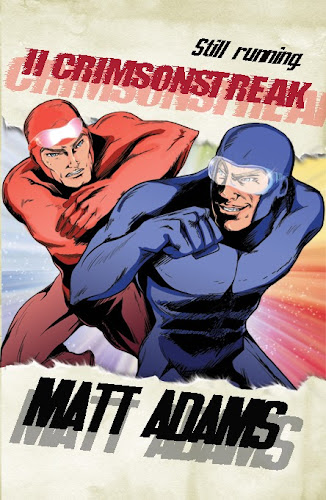
Showing posts with label matt adams author. Show all posts

Wednesday, March 19, 2014

Crimsonstreaking in Madison... and eventually at Hanover College


I took my Crimsonstreaking act to Madison, Indiana, this weekend for the Fourth Annual Authors Fair presented by That Book Place.

I've been to the event before and it's usually pretty busy. Last-minute construction on the Milton-Madison Bridge certainly didn't help with foot traffic. I sold a few books, but the best part was talking to other authors and swapping stories.

A couple of big comic book fans also interviewed me...and things got awkward (in a good way!). They were excited that I'd written a superhero novel and had lots of questions about the book. Both of the interviewers decided to sit (or stand, more accurately) in on the interview until we realized it wasn't working very well. It's the same reason I loathe three-man booths in sports. Anyway, we dumped out of the interview and I did a one-on-one with one of the hosts. Both guys were good sports about the whole thing.

We're not done Crimsonstreaking in southern Indiana! On March 29 and (maybe) March 30, I'll be down at Hanover College for Geek-a-Thon, their version of Comic Con. They'll have panels, movies, games, and plenty of activities. Since the theme is "Marvel vs. DC," it's certainly an appropriate forum for Crimsonstreak and company.

Helmet courtesy Stuart Thaman

Thanks to all who put the event together. I'd also like everyone to know that my wife indeed got to eat at Frisch's Big Boy. She ordered the patty melt. She was very excited about that.

Tuesday, February 18, 2014

III Crimsonstreak speeds off!

Although it's much later than I intended, III Crimsonstreak is racing (via email) toward Candlemark & Gleam!

I finished the appendices this week, and the book weighs in at a meaty 102,000 words. To put that in perspective, the previous two books were about 95,000 words each (with II Crimsonstreak being slightly longer than I, Crimsonstreak in total length).

In its current, unedited form, III Crimsonstreak's main story is about 85,000 words (similar to II Crimsonstreak, which was about 84,500 words but considerably longer than the original book, which was a much briefer 72,000 words).

As for the appendices, the third book is about 17,000 words. That's more extra material than II Crimsonstreak (11,000 words) and less extra material than I, Crimsonstreak (a whopping 23,000 words). The extra length of the third book's appendices is due to a long-form magazine article and a pair of short stories.

And, just because I like to fiddle with Photoshop, here's a completely unofficial mockup of a promotional banner:

Tuesday, January 28, 2014

Writing update

I've been working on a fairly intensive rewrite of III Crimsonstreak using my own notes and those from a beta reader. It's almost finished and ready to submit. I have some material left to polish and I have to work on the appendices. Like II Crimsonstreak, I'll probably only write about 10,000-12,000 words of extras. For comparison, I, Crimsonstreak had significantly more extra material--in the ballpark of 20,000 words.

Once I get that finished, I'll send it off to Candlemark & Gleam. I'm submitting later than I intended, but sometimes that happens.

This will be the third and final book of the Crimsonverse series, although I may do a couple novels set in the same universe. Crimsonstreak's story, I feel, is complete.

After that's finished, I'm working on a science fiction-comedy novel that I'm really proud of. I think it has a lot of potential, but I'm keeping details under wraps for now. I don't like to do that, but I'll have to in this case. The book is ready for a good polish and revision, and then I think I'll see if I can get any bites.

Friday, October 25, 2013

Fanboy Comics interview

I chatted with Fanboy Comics this week about I, Crimsonstreak and II Crimsonstreak.

The interview with managing editor Barbra J. Dillion touches on lightening up the superhero genre, works in progress, and other superhero goodness:
BD: How soon may readers anticipate the final installment of the trilogy, III Crimsonstreak? Have you already begun work on the book?

MA: I’ve finished the first draft of III Crimsonstreak and am working on revisions before I submit it. It’ll be approximately the same length as the second book and tie up the plot. The third book’s in a pretty good place right now as far as first drafts go. I’ve got some character moments to nail down and some third act plot machinations to smooth out. I expect a release late summer/early fall next year as long as I get it submitted early enough.
Be sure to check out the entire interview.

Tuesday, October 22, 2013

Progress report

After announcing that I'd finally chosen my next project, I'm going gangbusters on it. The paranormal novel involves a hotshot TV reporter, and I've really made some good progress over the last week or so. My work-in-progress currently stands at about 20,500 words. I'm gunning for about 85,000, so I'm a little under a quarter of the way there. I've been particularly productive over the last four days, averaging about 3,000 words/day (I've been on vacation this week; so much easier to write when the day job is on the shelf!).

Right now, the working title is The Exclusive (I'm also considering The Source). I have an outline, but I find myself going back and making changes or adding to it as I write. That happens sometimes. The first draft of my last project (I haven't announced the title) didn't need many changes to the outline. It really depends on the book and what happens as your write. I've recently discovered that I don't need a hyper-detailed outline, but I do like to go back and check my progress, adding little details and thoughts about the book as I go along.

Tuesday, October 15, 2013

II Crimsonstreak release day!


Oh, yeah!

II Crimsonstreak is out today!

Follow the continuing adventures of the pop culture-loving superhero as he races to save not only the Earth...but the entire multiverse. He'll team up with some of his closest friends--like his girlfriend Jaci and the Crusading Comet--and get "help" from snobbish intergalactic space cops and a noble birdman.

It's all awaiting you in II Crimsonstreak from Candlemark & Gleam!

Here are the links:

Candlemark and Gleam
Amazon

Sunday, October 13, 2013

New (micro)review of I, Crimsonstreak and II Crimsonstreak

Nerds of a feather, flock together reviewed both Crimsonstreak novels!

Overall, they liked what they saw.
This is superhero fiction more in the vein of The Incredibles than The Dark Knight....With the end of the first novel and the start of the second (which follows neatly on from the plot of the first), I was becoming a fan of Adams and a fan of Crimsonstreak.
Read the full--well, it's more of a "micro" review, actually--here.

Thursday, October 10, 2013

I've finally chosen a new project

After debating things for a while, I chose a new project. The idea actually came out of a writing retreat from February, and I tucked it away. I'll be splitting time between edits on III Crimsonstreak and writing the new novel.

Right now, I can't really say much about it. I have a rough outline, but now that I've written about 2,400 words, I'm going to go make a more detailed one. Sometimes you have to write a little bit of a book before you know what it's going to be, and that's the case with this one.

It has some paranormal/supernatural elements and the main character is a TV news reporter. As I've worked at a TV station for my entire professional career, I plan to draw on my experiences for this book.

I don't have a working title, but it will be something from the TV news industry.

Monday, September 23, 2013

Ready for II Crimsonstreak?

We're off and running on the preorder campaign for II Crimsonstreak!

Candlemark & Gleam runs these through a Kickstarter campaign that provides a tiered structure for anyone interested in getting the book. The tiers range from the most basic (a paperback copy of the book and the digital version) to one that includes a hardcover edition and a bunch of goodies.

My favorite tier is probably the bundle, which gets you both I, Crimsonstreak and II Crimsonstreak.

Rewards include signed copies of the book, posters, and a magical cosmic headband.*

Get your copy at the Kickstarter page.

*magical cosmic headband does not actually grant magical cosmic powers

Friday, September 13, 2013

II Crimsonstreak in Publishers Weekly

I got a pleasant surprise today when I learned Publishers Weekly reviewed II Crimsonstreak. We didn't get a review from them for I, Crimsonstreak, so I wasn't expecting it.

"...the story will nevertheless appeal to superhero fans with its absorbing worldbuilding and its warm, engaging protagonist."

Check out the blurb at the Publishers Weekly website.

The book is due out next month from Candlemark & Gleam.

Wednesday, August 28, 2013

Back at it!

After being in a big writing slump over the past few weeks for a variety of reasons, I'm back at it. A big thing about writing is that you have to have to do it. You can talk about it all you want and discuss the business side of things, but writers gotta write.

I really like the concept of my current work-in-progress. It has nothing to do with superheroes. Pop culture plays a major role in it. I'm not quite ready to share the concept just yet.

The book was at about 50,000 words when I stopped writing it a few months ago. I ended up going through revisions for II Crimsonstreak and then worked on III Crimsonstreak. Because of that, this book went by the wayside. I'd written the first 50,000 words pretty quickly, but returning to it proved problematic. I needed to read the whole book again and make notes. I struggled mightily to get back into my characters' heads and then set aside some time to outline the plot.

I'm happy to report that I'm back into the swing of things.

Saturday: 3,600 words
Sunday: 1,100 words
Monday: 1,500 words
Tuesday: 2,000 words

I'm averaging about 2,000 words/day over four days. I feel that surge of momentum and know there's a long way to go before I have a first draft. If I can keep up this pace, I should have a first draft completed in about three weeks.

Then, it's likely time to revise III Crimsonstreak and try to figure out what to write next.

Monday, August 19, 2013

Dealing with 'Crutch Words'

We have a multitude of words in the English language. As a writer, that means I have a huge toolbox to pull from. Sometimes, though, I don't do a very good job of pulling out a different tool; I instead find myself reaching for the same ones over and over again. It's part of being human; we all have tendencies and comfort zones.

I find myself leaning too often on certain words and phrases. These are crutch words--familiar phrases I use far too frequently. The thing is, sometimes I don't realize that I use them. Thanks to editors and beta readers, I have a better sense of the words I use too much. How do I deal with them?

Identify. The first part is actually the hard part. Many of these words are ones I use without realizing they're crutch words. There are couple of ways to figure out which words/phrases are problematic. The first one is to put a manuscript aside to get it out of your "mindspace." Then, when you read through it a few weeks later, you'll be more likely to see repetition within your own work. I'd also suggest reading in a couple different formats; you're likely to see something on paper that you might not see on your computer screen. I read a lot of my manuscripts on my Kindle.

The second step is the more effective one: consult outside people. These crutch words are so intrinsically tied to your writing that you don't realize it. Even getting some space from a manuscript isn't enough. You need someone else to read your work and help you identify these words. That can be an editor, a beta reader, a critique partner, or a friend. Since they're not you, they'll be able to spot instances in which words appear too often.

As an aside, it also doesn't hurt to check out a couple of different manuscripts or short stories at the same time. If it's a problem in one story, it's likely to be a problem in another. This will increase the size of your writing sample and help you identify your crutch words.

Make a list. This one's simple: write them down. While doing a significant revision on a novel I've been working on for a long time, I noted my crutch words on my Kindle and then wrote them down in a notebook.

For revisions:

Destroy! (or Replace!) I use Microsoft Word, but I imagine most other word processors have a "find" and "find and replace" function. Take that list of crutch words and search a manuscript to see how often you've used them. A few instances of a particular word are fine, but if you find a bunch clumped together or a certain word or phrase appears every few pages, you have a problem. You can use the "find" function of your word processor to locate the specific place where you've used a crutch word and then rewrite that section.

For writing:

Internalize. Now that I have an idea of what words I use too frequently, I can catch myself using them when I write. I won't stop myself every time--when I get into a good writing "zone," I want to stay there--but I can reduce how often I use certain words.

Some of my crutch words:
  • pointed
  • turned
  • seemed
  • boomed
  • thundered
  • eyes pleading
  • shook his head to clear it
  • tapped his forehead
  • looked/heard/saw
  • anything to do with a "cape flapping in a non-existent breeze"

How do you deal with crutch words?

Friday, July 26, 2013

Waiting for the next project

Well, we've had some busy times lately. Kind of.

I blogged last week over at the Candlemark & Gleam website about the importance of being ready when you submit. We also unveiled the stellar cover for II Crimsonstreak by artist Brooke Stephenson. We're looking at a release date of October for the Crimsonstreak sequel.

That leaves me wondering what my next project should be. III Crimsonstreak is off to Super Beta Reader Mike. I just finished polishing The Franchise as I prepare to send it around (it still needs another beta read before I do that). I have a half-finished book with a terrific premise that needs about 40,000 more words before the first draft is complete.

I just don't know what to do next.

I do know that I'd like to get III Crimsonstreak ready to go by the end of the summer/early fall. However, until I hear back from my beta reader, I can't do a whole lot of work on it. I'll re-read it and make notes, but I need someone to give me the "outside view" of the novel and its inner workings. I think the last act is problematic and needs more setup in the earlier parts of the book.

So what should I work on?

I have a space adventure book about a former gladiator trapped on a planet that I really like. I wrote it a couple years ago, but it needs some major polish. It's not exactly pleasant to read through because some of the writing is rough, but I'm more adept at fixing it now. The title of that one, by the way, is Sheridan's Hammer. I really like the main character in that one. Hmmmm.

I haven't written any new words in about a week. I have to figure out something to work on. Quickly.

Thursday, July 18, 2013

Cautionary Crimsonstreaking: Don't submit until you're ready

Note: the following is re-posted from a guest post on Candlemark & Gleam's website

Don’t submit your stories before they’re ready… or before you’re ready.

Just… don’t.

I originally wrote I, Crimsonstreak in 2007. Back then, the book had no appendices and consisted of about 50,000 words. The basic framework of the story—an imprisoned superhero busts out of prison to find his father in charge of a fascist world government—was there. From a very basic structural standpoint, many elements of the original draft are recognizable when compared to the published version.

Over a period of four years, from 2007 to 2011, I whipped it into shape, polishing things, adding scenes, tweaking dialogue, etc. I even queried agents. I laugh at that now—Crimsonstreak wasn’t ready. There are no fast tracks to publication, even if you’re the Fastest Man on Earth.

By 2009, I came to my senses and stopped querying. I realized the book wasn’t ready. More importantly, I wasn’t ready. You see, young writers tend to think their first book is absolute gold. They think someone should recognize their talent and dispatch a dump truck full of money to their driveway. I was young, I was creative, and I thought that’s how it would work. Looking back, I now know that’s a clear indication of how ready I wasn’t.

Truly, Crimsonstreak didn’t start to take shape in its current form until late 2010. I set fire to the manuscript and made radical changes. More importantly, I sent it to a beta reader, a ruthless colleague who isn’t afraid to use phrases like “this doesn’t work” and “that doesn’t make sense” and “where in the hell is the character arc here, Adams?” and “you realize this whiny Warren Kensington IV character is terrible, don’t you?” We bounced ideas back and forth. I made more changes.

Our conversations were pivotal. Whiny Warren Kensington IV became a stronger character. The legacies of Crimsonstreak, his parents, and the Crusading Comet became intertwined. I found a way to introduce tension among Warren, Morty, and Chris—tension that was far more personal than it was in prior drafts.

I sank four years into Crimsonstreak. After giving it another three months, I felt it was as good as it was going to get.

I sent it to Candlemark & Gleam in the summer of 2011. Make no mistake: this was Crimsonstreak’s last stand. Had there not been a request for the full manuscript, Crimsonstreak and company would likely be sitting on my hard drive as “crimsonstreakcometrevision.doc.” I would’ve moved on.

To my utter delight, Kate Sullivan saw potential and requested the full manuscript. We made more changes—if there’s anything you need to understand about writing, it’s that there are always changes. Overall, though, the published version of I, Crimsonstreak isn’t much different from the version submitted in May 2011.

On the other hand, it’s worlds apart from the 2007 version with the file name “Hero.doc.”

Now here’s the funny thing. While a young writer gets a little full of himself or herself for no reason, an “experienced” writer does, too. When I started writing the sequel, I produced a first draft, showed it to my beta reader, made some revisions, and then sent it off.

II Crimsonstreak was not ready. There’s no way I should’ve sent the book away. I had character arc problems, I had an excess of plot aerobics, I had an “ending” that relied too heavily on shock with no real resolution or reflection.

I know that now. I should’ve known it then. Maybe, deep down, I did, but thought my newly acquired skills as Published Author would override any issues with the book.

It doesn’t work like that.

The development cycle for the sequel was much shorter. This isn’t to say you can’t write a good book in a short amount of time. It’s certainly possible, and some authors can pull it off. I wasn’t that guy yet. I just thought I was.

I concocted this story about multiple realities and rival factions. I forged ahead with an outline that touched upon basic plotting, character arcs, and scenes. Then I went to work. A thousand words a day. Then, 2,000 words a day. Sometimes even 5,000 words a day. First draft. Boom. Done.

Back up the dump truck full of money.

My “outline” was a couple of pages written in my trusty “idea notebook.” It didn’t actually outline anything. I was planning a road trip that marked the start and end points without considering things like road construction, speed limits, rest stops, or scenic routes.

Even worse, I made a major change without re-plotting the story. The result was a muddled mess. Characters’ goals were unclear. The motivation of the villains was unclear. Jaci Graves, a terrific character, got pulled into “token love interest” territory, a role that she would absolutely punch me in the jaw for assigning her.

My beta reader brought up these issues. I “fixed” them. Even though I needed to do more work, I sent II Crimsonstreak to C&G. Part of it was eagerness—I wanted Kate to read the story. Part of it was stubbornness—I didn’t want to miss a self-imposed deadline. Part of it was brashness—I figured the book’s strengths and my strengths as an author would carry it through.

I was partially right about the last part, but not because of the book.

If II Crimsonstreak had been the first thing I’d ever sent to C&G, it would’ve been rejected. However, Kate and I had a good, collaborative relationship from when we polished Crimsonstreak, so she had confidence that I could take that mess and turn it into a good book.

Revisions lasted three more months as I waded through notes and added new touches. I scrapped some self-indulgent passages, streamlined the plot, wrote an actual ending (well… kind of), and developed clearer character arcs.

It all worked out in the end, but I learned some valuable lessons along the way—proving that Published Author doesn’t know anything.

Let’s use some bullet points to hit my main ideas:

  • Don’t submit anything before you’re truly ready; for the most part, you get one shot
  • Outlines are good and can focus you; they don’t have to be super-detailed chapter-by-chapter summaries, but they should have some substance
  • If you make a major plot or character change, adjust your outline so you have a good idea where that change will take you; you’ll burden yourself with a lot of work otherwise
  • In some ways, the second book is harder than the first; development time will be shorter, you may be overconfident, and the resulting novel could very well get messy
  • Revisions are a major part of the process; you don’t have to like them, but you sure as heck had better get used to them if you want to put out a good book
  • Building a good relationship with an editor and working hard for them will buy you some goodwill when your novel doesn’t quite turn out as well as you’d hoped
  • Do not turn Jaci Graves into a token love interest; she will punch you in the jaw

Monday, June 24, 2013

To Revisioning and Beyond: Remaking the The Franchise

A few years ago, I wrote a superhero book that was completely different from I, Crimsonstreak. Whereas Christopher Fairborne gives the genre the tongue-in-cheek treatment, this other book (The Franchise) takes a more serious look at the world of superheroes. It's a mix between The Firm and Watchmen set in a retro-futuristic 1960s with pulp heroes thrown in for good measure.

I really believe in this book and its concept. I've worked on it off and on for several years. Based on a pitch, I had an agent request it in 2010. The agent passed.

I've learned a lot more about writing and publishing since then. I'm far from an expert--just ask my publisher about the draft of II Crimsonstreak I submitted--but I'm a better writer than I was in 2010. When that agent passed, I took it hard. It was early in my writing journey, so I felt that was it. The Franchise was a terrible concept and would never work.

After I, Crimsonstreak came out, I started playing with The Franchise some more. I added a new character who's so essential to the book that I don't know how I wrote it without her. I fleshed out the setting--an area I tend to struggle with. I tried to make the main character more of an active part of the story instead of a character who was simply driven by the events around her. I wove in more backstory and added another layer to it.

A draft that was 75,000 became 80,000 words. I didn't cut content as much as I rewrote large sections of text. I created snippets of newspaper copy and text from a company handbook (a concept familiar to anyone who's flipped through Crimsonstreak and its appendices). More satisfied with the direction of the book, I needed a second opinion.

I sent it to my Beta Reader Extraordinaire. This wasn't a high-priority project--I was working on III Crimsonstreak and didn't need immediate feedback--so I told him to take his time. Because he's either partially insane or really, really good at what he does, he sent me pages upon pages of notes. These included suggestions on character arcs as well as things to look at in each chapter.

I went through the feedback and it became clear to me that simply "rewriting existing parts of the book" wouldn't work. Not only did I have a plot MacGuffin that I didn't like, my protagonist still wasn't fully-formed. A major supporting character also ended up being a bit shallow. The novel got too talky at points, so it needed another bit of action. The new character added to the book deserved more scenes and needed to be interwoven into the fabric of the story. The supporting characters--and there were a lot of them--needed to be more memorable.

So, while I haven't been writing anything "new," I have been adding to The Franchise. I'm not ready to give up on it yet because I feel there's a fantastic book hidden in there. The narrative needs to be pulled apart, rearranged, and given several more generous coats of polish. That's what I'm doing now.

In addition to rewriting large sections, I've trimmed a bunch of words and added new scenes. The current draft stands at about 91,000 words. I'm about a third of the way through this latest revision.

It's not always easy to finish a draft of the book and forge ahead with more revisions, but the more you do it, the less you dread it. I've gotten to the point--after getting over the initial shock of "the draft isn't perfect"--where I enjoy revising.

To revisioning and beyond!

Wednesday, June 12, 2013

Cover collaboration and the rise of the multiversal mustache

I made a last-minute adjustment to the "final" revision of II Crimsonstreak on Tuesday night. A character's mirror-world doppelganger ended up getting facial hair, a play on the much loved trope from the "Mirror, Mirror" episode of Star Trek. It's not exactly Spock's goatee, but it's close enough.

I didn't think of this myself, actually. This addition was part of the collaborative process of putting a cover together.

I'm working with my editor Kate Sullivan and talented artist Brooke Stephenson (who did the cover for I, Crimsonstreak) to come up with a cover for the sequel. I had a fairly clear idea of what I wanted. The idea was so clear, in fact, that I created a mockup in Photoshop. I'm decent with Photoshop, but my skills as an illustrator aren't professional grade. Still, I like to think I have a decent idea of how things look.

The cover for the first Crimsonstreak book went through a few different versions. We ended up going with a fantastic design Brooke made based (very, very) loosely on a concept I had for the cover. Trust me, I was as surprised as anyone when the cover concept ended up being something I came up with while fiddling with Photoshop. Brooke added the key touches that made the book come alive, such as the illustration of Crimsonstreak (my mockup used the Flash as a stand-in) and the idea to use newspaper cutaways to fill in the white space. The latter was a nod to the newspaper articles in the appendices and the character's background in journalism.

So, when it came time for II Crimsonstreak to go through the cover design process, I came up with a concept cover that echoed the first one. Seriously. The cover mockup I sent to Candlemark & Gleam utilized the same basic layout as I, Crimsonstreak, ripped pages and all. I even used the Flash again. Crimsonstreak meets a character in the second book named the Bluestreak who can outrun him. I pulled a page out of the Mortal Kombat palette-swap playbook, using a "blue" Flash and a "red" Flash to represent the Bluestreak and Crimsonstreak, respectively. Brooke will use that as a template and make it 800 million times better. I can't wait to see what she comes up with.

I'm really, really excited about the back cover. I mean...super stoked. Brooke plans to draw five comic book panels that echo comic's Silver Age. She'll use scenes from the book as the basis for these illustrations. So while the comic book characters of the Crimsonstreak-verse don't take form in a traditional comic book sense because it's a novel, Brooke will breathe life into several of them. Her rough, proof-of-concept sketches put a big smile on my face.

One of the characters caught my eye because she'd drawn him with a mustache--something I hadn't considered. We're dealing with an alternate universe doppelganger (yes, yes, again), and while I had written a specific physical difference between the character and the "real" version of that character, I hadn't considered giving him a mustache. Brooke's sketch convinced me he needed one, so I made a last-minute change to incorporate that particular feature as a gag.

I didn't have to do that. I could've told Brooke to forget about the mustache. I am, after all, the creator, right? Yet something about her drawing felt right, and I couldn't ignore that feeling. Now, that character has a multiversal mustache, all because of a little collaborative effort among Brooke, Kate, and me.

People will tell you that you lose a few things when you decide to go with a small press. That's true. But for every "take," there's also a "give." I get to help design the cover of my book--something a lot of authors think about but don't usually get to have much input on. The collaborative process of that design, in turn, ended up making a nice little addition to my novel. It's a minor change that amounts to nothing more than a few references, but it adds something memorable.

And for that, I'm grateful.

Thursday, June 6, 2013

Game of (Writing) Thrones

About a year and a half ago, I said goodbye to my trusty writing chair. After I acquired it in 2004, the chair survived two moves, seven novels, and several dozen short stories. It also lived to tell the tale after my brother and I almost killed each other while putting the blasted thing together (weren't not exactly engineers).

Toward the end of its days, Old Reliable looked like this:


That chair, which lasted nearly eight years, had to be replaced. We took Old Reliable to Goodwill in hopes that someone could fix it up and make something out of it. We played "Amazing Grace" on the bagpipes...it was an emotional time.

After fighting fits of uncontrollable tears, I finally bought a replacement. I assembled New Chair myself, expecting Old Reliable's successor to last just as long. It appears, though, that the daily process of butt-in-chair writing was too much for New Chair to handle. The fabric ripped and it started leaning to the right after about a year and a half. Here's how it looked:


Sure, it doesn't look that bad. Just try sitting in it. The snowman, by the way, is a sign that winter is coming for New Chair. It's getting a sendoff as well:


I don't know why Spock isn't there--we sent him an invitation. And before you get any fancy pants, J.J. Abrams-rehash ideas, we didn't launch the chair toward the Genesis Planet. Right out the torpedo tube for this one. No "Amazing Grace"--just pure explodey.

Old Reliable's gone. New Chair's a distant memory of inferior craftsmanship and space debris. What's next?

I have to have somewhere to sit when I write. I need a place to work on rewrites for III Crimsonstreak and polish The Franchise. Here it is:


I don't know what to call it yet. I just hope it's more like Old Reliable and less like New Chair. Because New Chair is a disappointment, like the Xbox One reveal and the Star Wars prequels. And Game 7 of the Eastern Conference Finals.

(This post was partially inspired by Cathy Day's piece on Writing Machines & Writing Spaces)

Monday, June 3, 2013

Another quick update

I plan to turn in "final" revisions on II Crimsonstreak by the end of the week/weekend. My rewrite fixed most of the issues with the book. Obviously, when you rewrite something significantly, you'll always find little bits that need to be tweaked. While reading through the book on my Kindle, I also spotted a few misspellings. I have to correct those and look at a few dozen notes I made while reading the manuscript. We shouldn't be too far off from having a cover reveal.

I'm also rereading III Crimsonstreak and making some notes on it. I want to give it some more polish before sending it to Beta Reader Mike. I need to consolidate a few things that happen in the last third of the book with events from the first third.

After that, I need to figure out which project I want to do next. I have a fantastic idea for another novel (one that's actually not a superhero book). I also have a book that's about 60% finished; I should probably go back and finish that (and re-plot the last act). I'm leaning toward working on the latter. I have a tendency to want to work on something new ("Oooo...ooooo...SHINY!") and leave other projects aside. It's very difficult to finish anything that way.

Thursday, May 16, 2013

II Crimsonstreak revisions and notes on III Crimsonstreak

I'm wrapping up the last book in the Crimsonstreak series. I didn't set out to write a trilogy...it just kind of happened. Currently, the end of the book feels a little too much like the end of Peter Jackson's Return of the King. By that, I mean there are several plot threads/character moments to resolve. A few character threads got lost throughout the first draft and will need to be added during revisions.

It's tough saying goodbye to these characters. I'm not saying I'll never revisit them (in fact, I have an idea for a book based solely on Mortimer P. Willoughby that traces the history of Morty and the various Crusading Comets), but I'm going to take a break from this particular group of superheroes. I can't say much about the book (or II Crimsonstreak for that matter), but Christopher Fairborne goes on quite the journey. He has to learn to say goodbye and let go of many of the people close to him. So, as he says his goodbyes, I say my own to those characters. The ending packs an emotional punch...and I hope it translates for readers.

III Crimsonstreak is a long way off, though. That manuscript will have to be revised, I need to come up with some appendices, and my Super Beta Reader will have to Super Beta Read his way through it. Even in the best case scenario, in which I turn it in at the end of summer, we're looking at we're looking at a spring/summer release. But I'm getting waaaaay ahead of myself.

Let's talk about II Crimsonstreak. I received edit notes back from the massive revision I did on the book. Seriously, it was like performing major surgery (or at least my fictional conception of what performing surgery is like). Mastermind Kate at Candlemark & Gleam was very pleased with the edits. I have about two weeks or so to go through the additional markups and make any changes, a process I plan to start this weekend after wrapping up III Crimsonstreak's first draft.

Make no mistake, II Crimsonstreak revisions were a major undertaking. The book had a great concept, but my execution was lacking (I'll do a separate blog post about this soon). I twisted myself up in plot threads, had dodgy character motivations, and underutilized a major character. I some parts, our fair protagonist acted like a jerk simply because it was convenient for the plot.

No more.

I've fixed most of that, meaning that my biggest concern revolves around whether Falcon Gray has a beak or not. I think I can live with that.

We're shooting for an October release.